When industrial plant managers, commercial real estate developers, and operations directors evaluate the structural health of their properties, they tend to audit the highly visible components of their production lines: manufacturing machinery, server rack cooling frameworks, automated shipping bays, or interior safety arrays. Yet, the most financially vulnerable component of any enterprise building is completely exposed to the elements, sitting quietly above their heads.
Traditional commercial roofing programs have operated under a flawed, reactive paradigm for nearly a century. An inspector ascends a fixed ladder with a handheld flashlight and a clipboard, looking for obvious tears, split seams, or standing water pools only after an interior drip interrupts a multi-million-dollar production line.
Waiting for a physical leak to show itself inside an active manufacturing plant or data center is a massive operational failure. By the time water drops past a ceiling beam, thousands of liters of rainwater have already saturated the internal insulation boards, rotted the underlying steel or wood roof deck, and created hidden pockets of structural decay.
To safely protect massive commercial real estate investments from these hidden threats, forward-thinking enterprises are replacing slow manual checkups with a highly integrated, tech-driven defense ecosystem: roof cyber-telemetry systems.
                    relentless UV & WEATHER SYSTEMS --->
            ____________________________________________________
           /                                                    \
          /     SOLAR EXPOSURE & EXPANSIVE THERMAL LOADS        \
         /                                                      \
        v                                                        v
  +----------------------------------------------------------------+
  | [Engineered Roof Cyber-Telemetry System Shield]                |
  |   \__ Nanotech Polymer Shielding & Continuous Aerial Auditing  |
  |                                                                |
  |          Flawless Predictive Lifecycle Building Asset Safety   |
  +----------------------------------------------------------------+
Modern commercial property protection demands that we look beyond basic patchwork solutions. True protection requires a complete shift in how we handle the building envelope. By combining the chemical defense of high-solid nanotech silicone polymers with the real-time auditing power of cloud-connected aerial scanners, industrial buildings can completely isolate themselves from severe weather.
When you connect real-time surface metrics directly with enterprise-grade tracking platforms, handling vast property portfolios becomes a seamless, predictable operation. Instead of juggling loose contractor estimates, unverified field invoices, and messy maintenance folders, property directors can track every step of their roof inspection schedules, capture critical field data, and measure long-term project success on a single digital hub.
Shifting from standard reactive roofing habits to an automated, predictive maintenance strategy is the single most effective way to eliminate unexpected utility spikes, protect expensive interior inventory, and extend your building’s structural life for decades to come.
QUICK TAKE / SNAPSHOT BOX (Featured Snippet Optimized)
- Eliminates Material Thermal Shock: Deploying bright, ultra-high-reflectivity white polymers bounces away up to 88% of solar radiation, dropping afternoon roof surface temperatures by up to 28°C.
- Exposes Trapped Insulation Wet Spots: Utilizing advanced roof cyber-telemetry systems spots trapped sub-surface water pockets long before they cause expensive structural damage.
- Organizes Large Portfolio Maintenance Workflows: Connecting real-time aerial inspection data with cloud tracking software unifies team operations under a single system.
- Prevents Severe Chemical Decay: Modern nanotech polymer applications deliver a seamless, puddle-proof barrier that stops ponding water from breaking down roof seams.
- Drastically Lowers Facility Cooling Load: Minimizing solar heat absorption limits internal heat gain, cutting commercial air conditioning electricity expenses by 15% to 30%.
- Removes Expensive Safety Hazards: Deploying autonomous drones removes the dangerous liability of sending human crews onto high, fragile commercial roofs for manual checking.
The Thermodynamic Mechanics of Commercial Roof Decay
A premature failure on an industrial low-slope roof line is rarely caused by low-grade base materials. Instead, it is driven by two continuous, destructive forces working together: severe solar radiation absorption and trapped subsurface moisture accumulation.
During peak summer afternoons, dark, unoptimized roofing surfaces act as massive thermal sponges, absorbing intense solar energy and pushing roof surface temperatures past 75°C. This extreme heat retention triggers a continuous cycle of thermal shock. As the sun beats down, the roofing membrane expands violently; as night falls and temperatures drop, the material contracts rapidly.
                         [ Relentless Midday Solar Radiation ]
                               |     |     |     |
                               v     v     v     v
   SURFACE THERMAL SHOCK =====> +-----------------+
  --------------------------->| Dark Membrane   |
                              |                 |
                              | Split Roof Seam |
                              | Inside Heat Gain|
                              +-----------------+
This constant expanding and shrinking puts incredible mechanical stress on every flashings detail, field seam, and mechanical roof fastener. Over time, the internal chemical bonds of the roofing material break down, leaving it brittle, cracked, and highly vulnerable to tears.
When a traditional commercial roof lacks advanced protection, three distinct technical failure vectors can quietly compromise the entire building long before its expected lifespan is up:
1. Accelerated Material Photo-Degradation
Ultraviolet (UV) radiation constantly breaks down the chemical bonds of standard roofing materials. When high UV exposure mixes with intense surface heat, it causes the essential oils and plasticizers within roofing membranes to evaporate. This process leaves the roof brittle, faded, and highly vulnerable to fracturing under normal building movement.
2. Capillary Moisture Migration and Blistering
When a tiny hairline fracture develops along an unreinforced roof seam, rainwater creeps beneath the outer membrane layer via capillary action. As the sun heats the roof the next day, this trapped liquid water converts into expanding water vapor. Because the gas cannot escape, it generates immense upward pressure, creating large surface blisters that tear the membrane completely away from the underlying insulation boards.
3. Plywood and Metal Decking Structural Rot
When damp, hot air sits trapped against the underside of your roof panels without moving, the structural materials begin to degrade. In metal decks, the moisture causes the metal to rust and weaken; in wood decks, it triggers wood rot and delamination, where internal glues break down and the panels sag dangerously between the rafters.
   [Cross-Section of a Thermal Sub-Surface Failure]

   Layer 1: Brittle Cracked Membrane -> [ Elastic plasticizers evaporated by UV rays ]
   Layer 2: Expanding Sub-Surface Vapor -> [ High pressure creates massive blisters ]
   Layer 3: Rotted Structural Decking -> [ Wood or metal backing sags from trapped moisture ]
Relying entirely on manual human checkups to manage these complex thermodynamic processes is a losing battle. By the time an inspector can visually spot a roof defect from an access ladder, the internal structural damage has already spread across hundreds of square meters of sub-base insulation.
True structural safety requires moving past simple visual lookups and building an advanced defense line that treats the entire roof as an active, data-driven security barrier.
The Chemical Defense: Airless Nanotech Polymer Shields
To defend against intense UV breakdown and stopping moisture damage before it starts, modern chemical engineering has delivered an exceptional solution: high-solid silicone and fluoropolymer elastomeric coatings. These are not basic paints; they are advanced liquid-applied membranes that chemically bond with your existing roof surface to form an seamless, incredibly durable shield.
When applied using professional airless spray systems, these polymers fill into every microscopic crack, pore, and seam, transforming an old, worn roof into a highly reflective, completely waterproof shield.
  [Optimized Modern Cool Polymer Roof Design]
  +-------------------------------------------------+
  | Ultra-High SRI Bright White Elastomeric Coating |
  |                                                 |
  |      +-----------------------------------+      |
  |      | Fiber-Reinforced Polyester Mesh   |      |
  |      +-----------------------------------+      |
  |                                                 |
  |            +------------------------------------+
  |            | Fully Primed Existing Base Roof    |
  |            +------------------------------------+
  +-------------------------------------------------+
Unlike traditional asphalt or single-ply sheets, which rely on mechanical glues or heat-welded seams that can dry out and split over time, liquid-applied nanotech polymers cure into a single, continuous rubberized sheet. Because there are absolutely no seams across the entire roof surface, the primary point of failure for commercial roofs is completely eliminated.
Additionally, these advanced silicone compounds are naturally hydrophobic. They are completely immune to standing water damage, allowing them to easily handle long-term ponding water across low spots without softening or breaking down.
Furthermore, these bright white coatings deliver exceptional solar reflectance, bouncing up to 88% of solar radiation right back into the atmosphere. By keeping the underlying roof structure close to ambient air temperatures, these cool polymer shields provide vital protection against material expansion stress. This dramatic temperature drop protects the entire building envelope, prevents early chemical aging, and slashes internal air conditioning energy costs, transforming a passive roof into an active revenue-saving asset.
The Auditing Defense: Aerial Drone Data Integration
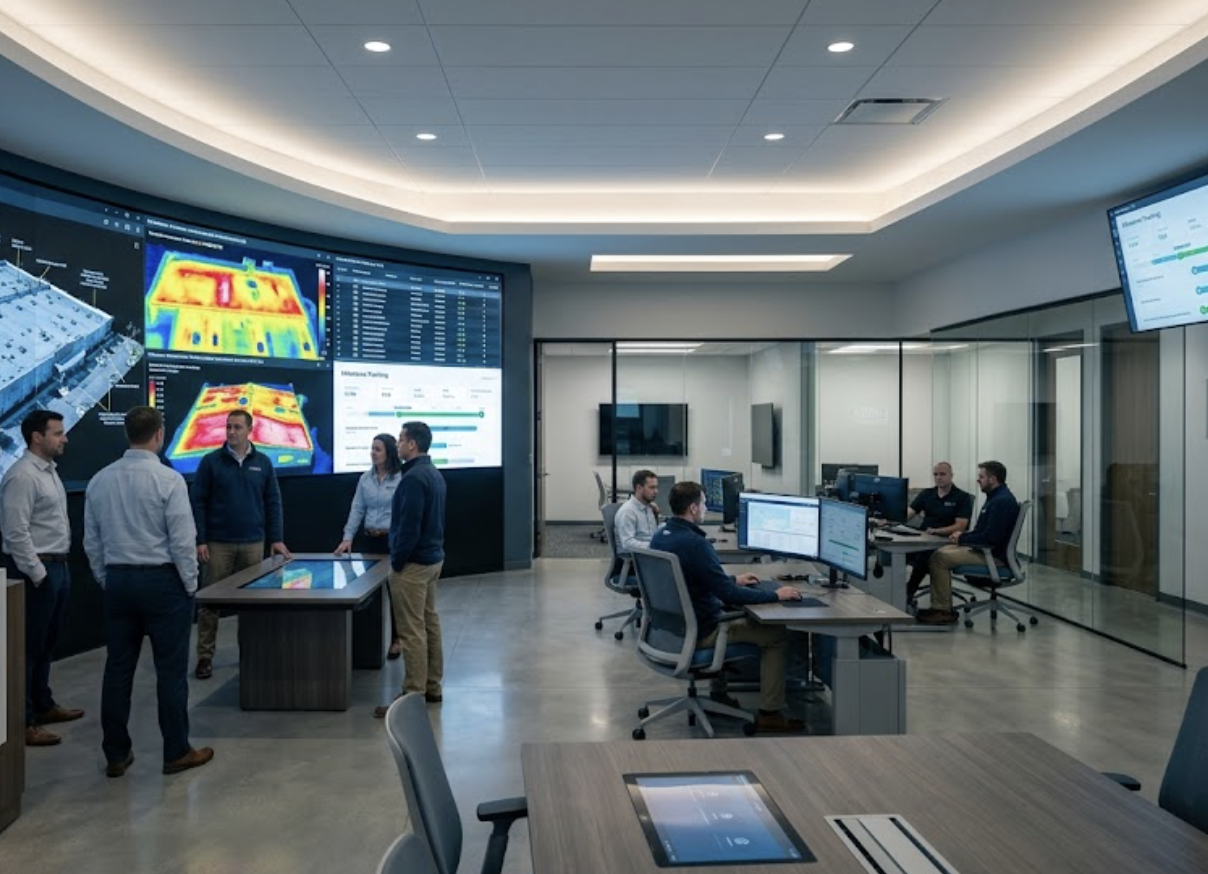
While advanced polymers protect a building’s exterior from severe weather, maintaining absolute safety across large property portfolios requires an organized, data-driven auditing program. This is where modern roof cyber-telemetry systems change the game, combining automated drone flights with advanced cloud analytics to track structural health with extreme precision.
Instead of relying on slow, dangerous manual inspections, asset managers can deploy autonomous drones equipped with multi-sensor payloads to map out entire roof systems down to the millimeter.
   [Automated Code Generation & Validation Flow]

   Step 1: Automated Flight Grid -------> [ Precise GPS routing ensures complete property coverage ]
   Step 2: Predictive Damage Matching --> [ Software automatically highlights hidden roof defects ]
   Step 3: Cloud Project Assignment ----> [ Managers assign field crews and track repair completions ]
By gathering multi-spectral light data, high-resolution thermal scans, and millimeter-accurate LiDAR measurements, these drone surveys expose hidden sub-surface flaws long before they turn into major structural emergencies.
For instance, because wet insulation boards hold onto daytime solar heat much longer than dry, functional materials, high-performance thermal sensors can easily spot trapped water pockets as glowing hot spots right after sunset. This allows your team to fix minor membrane tears early, preventing localized moisture from spreading across the entire roof deck.
When you stream these real-time aerial data profiles straight into a centralized project tracking engine, managing property portfolios becomes completely seamless. Instead of letting critical repair details get lost in isolated text messages or scattered field folders, facility directors can easily track ongoing project milestones, manage field contractor documents, and track maintenance success across your entire property portfolio using one single hub.
Moving away from slow paperwork and embracing modern field automation permanently eliminates unexpected building damage risks while drastically extending your property lifespans.
The Five-Stage Cyber-Telemetry Operational Framework
Successfully transforming raw field data and advanced coatings into a reliable, long-lasting property defense system requires an organized, step-by-step construction protocol. You cannot rely on unverified field methods or casual scheduling.
To ensure your facility gains absolute protection against heat and moisture, your installation team must follow a strict five-stage engineering framework built around roof cyber-telemetry systems.
  [Integrated Cloud Telemetry Pipeline]
  +-------------------------------------------------+
  | Automated Drone Survey Flight (Field Data)     |
  |                                                 |
  |      +-----------------------------------+      |
  |      | Automated Telemetry Data Upload   |      |
  |      +-----------------------------------+      |
  |                                                 |
  |            +------------------------------------+
  |            | Central Cloud Tracking Dashboard   |
  +-------------------------------------------------+
1. Perform Automated Initial Telemetry Mapping
The framework begins by deploying an autonomous drone to execute a pre-programmed, GPS-guided mapping flight across the entire roof area. This survey captures a highly accurate baseline dataset of the building, mapping out every vent, flashing detail, and existing defect to give your engineering team a crystal-clear guide for needed surface preparation.
2. Execute Deep Kinetic Cleaning and Patching
Once the initial map highlights the roof’s weak spots, your repair crew steps in to fix any active leaks, replace waterlogged insulation boards, and deep-clean the entire surface using high-pressure washing systems to remove all dirt, grease, and oxidized materials.
3. Apply High-Solid Nanotech Polymer Seals
Next, apply the premium liquid polymer coating across the clean surface using professional airless spray equipment. The team must follow precise application guidelines, executing a multi-pass cross-hatch pattern to achieve a seamless, thick white shield that provides maximum reflectivity and absolute waterproof protection.
4. Integrate Centralized Cloud Progress Management
Throughout the application process, all project updates, material logs, and quality checkmarks are synced straight to your central cloud dashboard. This immediate connection lets your main office track ongoing project milestones, manage field contractor documents, and track maintenance success in real-time.
5. Launch Post-Installation Assurance Auditing
After the polymer coating has fully cured, an autonomous drone completes a final verification flight to scan the completed roof shield. This post-installation audit confirms a uniform coating thickness, checks for total seam coverage, and logs the optimized thermal profile into your asset database, marking the official launch of your predictive maintenance program.
Analyzing Lifetime Operating Costs: Reactive Patching vs. Cyber-Telemetry Programs
Let’s look at real-world facility operating numbers to understand why continuing to use slow, manual inspection habits can quietly drain your company’s annual building budget. Many organizations try to save a quick dollar by delaying roof surveys until an obvious leak forces them to act.
However, when you calculate the real costs of replacing rotten insulation, repairing damaged warehouse inventory, and dealing with extensive interior mold remediation, reactive maintenance quickly becomes an incredibly expensive mistake.
Consider an enterprise logistics park featuring 100,000 square feet of commercial low-slope roof space.
An uncertified crew quotes a basic reactive plan, charging a low upfront fee to perform standard walk-around visual checks and patch leaks by hand after they break through to the interior.
A professional building science team quotes an advanced data-driven program, implementing a complete roof cyber-telemetry systems package that combines deep nanotech polymer shields with automated drone-to-cloud thermal tracking.
If the operations director chooses the traditional manual inspection method to minimize upfront costs, hidden sub-surface leaks will typically go unnoticed for years behind the scenes. This trapped moisture rots through large sections of insulation, causing a massive, unexpected failure during an intense rainstorm season.
Let’s look at how the real operating and emergency repair costs add up over a 20-year facility lifecycle:
  [20-Year Commercial Roof Capital Expenditures]

  Reactive Manual Patching: [$$$$$$$$$$$$$$$$$$$$] $385,000 (Includes Emergency Roof Rebuilds)

  Predictive Cyber Program: [$$$$$$$$$$$$$] $210,000 (Catching and Fixing Small Leaks Early)
                            ===========================================================
                            True Long-Term Capital Savings: $175,000 saved via tech-driven tracking
| Roof Maintenance and Operational Expenditures (20 Years) | Traditional Reactive Patching | Predictive Cyber-Telemetry Programs | Net Corporate Savings |
| Initial System Installation Investment | $45,000 | $95,000 | -$50,000 |
| Emergency Structural Patching Costs | $85,000 | $5,000 | +$80,000 |
| Full Interior Inventory Damage Claims | $95,000 | $0 | +$95,000 |
| Premature Roof Section Replacement | $115,000 | $0 | +$115,000 |
| Cumulative Extra AC Energy Bills (20 Years) | $45,000 | $11,000 | +$34,000 |
| Total 20-Year Lifecycle Expenses | $385,000 | $210,000 | +$175,000 Saved |
Look at that significant bottom-line difference. Choosing the manual approach actually caused the facility to lose an extra $175,000 in entirely avoidable emergency building expenses and premature roof replacement costs.
The minor upfront savings faded quickly after the first hidden leak spread, proving that outdated maintenance habits generate massive financial liabilities for your company over time. Running large-scale properties without utilizing precise data collection is a risky, unpredictable gamble.
The only reliable way to protect your physical real estate assets is to build a modern, data-driven management strategy straight into your ongoing facility planning.
Technical Performance Matrix: Systems Under Extreme Environmental Loading
The performance gap between old-school roofing habits and automated, tech-driven asset management becomes completely clear when you look at how different approach levels handle complex structural flaws and sudden weather challenges.
   [Property Management Efficiency Spectrum]

   TRADITIONAL MANUAL CHECK: [*] High Error Risk / Misses Hidden Insulation Damage
   BASIC SINGLE-PLY SHEETS:  [***] Moderate Protection / Vulnerable to Split Seams over Time
   INTEGRATED CYBER SHIELD:  [*****] Absolute Property Security / Full Cloud-Synced Field Automation
| Roof System Performance Property | Traditional Asphalt Built-Up | Standard Single-Ply Sheets (TPO) | Premium Integrated Cyber-Telemetry Shields |
| Seamless Surface Integrity | None (Features multiple layered joints) | Low (Relies on heat-welded field seams) | Absolute (Cures into a single seamless sheet) |
| Ponding Water Resistance | Poor (Softens and breaks down quickly) | Moderate (Seams weaken under standing water) | Excellent (Hydrophobic silicone is 100% immune) |
| Defect Detection Accuracy | Low (Misses hidden leaks below surface) | Moderate (Only spots clear surface damage) | Perfect (Finds hidden insulation moisture instantly) |
| Daily Thermal Expansion Stress | Extreme (Causes severe joint damage) | Moderate (Standard material shifting) | Minimal (High-SRI coating stops thermal shock) |
| Field Data Synchronization Speed | Slow (Manual reports take days to type) | Moderate (Manual file transfers via flash drive) | Instant (Fields reports sync with cloud engines live) |
Connecting Telemetry Data to Predictive Financial Planning
Integrating high-resolution field analysis directly into your enterprise asset management workflow does more than optimize immediate maintenance tasks; it completely transforms your long-term capital allocation strategy. Instead of projecting future facility overhead costs using basic historical averages or arbitrary lifespans, executive teams can leverage precise degradation maps to predict exact structural replacement cycles with unmatched accuracy.
This continuous flow of real-time field information allows financial directors to transform unpredictable emergency capital expenditures into smooth, highly scheduled structural upgrades. By eliminating the massive financial variance associated with catastrophic roof failures, your organization can keep liquid capital working across high-yielding investments rather than leaving it trapped in an emergency building reserve fund.
FAQ Section (SEO + AI Overview Optimized)
How can a flying drone find hidden water leaks under a flat roof?
Drones use advanced thermal cameras to scan your property right after sunset. Because waterlogged insulation traps heat longer than completely dry materials, the wet sections stand out clearly as bright, warm areas on your inspection maps, showing your repair crews exactly where water is trapped.
What are the benefits of liquid-applied nanotech polymer coatings?
Unlike traditional sheets that rely on glued or welded seams, liquid-applied polymers cure into a single, completely seamless rubberized sheet across your entire roof. This design permanently eliminates seams—the primary point of failure for commercial roofs—while providing complete immunity to standing water damage.
How do reflective cool coatings help lower monthly energy bills?
By reflecting up to 88% of solar radiation away from the building envelope, cool polymer systems drastically limit the amount of heat that transfers down into your interior spaces. This reduction keeps indoor areas naturally cooler, allowing your facility’s air conditioning systems to run less often and save energy.
Can drone telemetry replace traditional human roof inspections?
Yes, drone telemetry replaces the guesswork of traditional visual inspections by providing far more accurate data layers, such as thermal scanning and LiDAR mapping. This advanced approach keeps crews safely on the ground while delivering clear, data-driven insights that a human inspector simply cannot see.
How often should an enterprise run drone telemetry surveys?
For maximum protection, commercial buildings should receive automated drone surveys at least twice a year—ideally once in the spring and once in the autumn. It is also wise to run quick scans after intense hailstorms or major weather events to catch and resolve minor surface issues early.
What is thermal shock and how does it damage roofing systems?
Thermal shock is the rapid expansion and contraction of roofing materials caused by extreme daily temperature swings. This constant physical movement puts immense structural stress on seams and flashings, eventually tearing joints apart and creating hidden entry points for water.
Securing the Future of Your Enterprise Portfolio
Protecting your enterprise properties isn’t about waiting for an obvious structural leak to disrupt your daily business operations—it’s about respecting the true value of your real estate investments and actively using modern, data-driven systems to solve property issues long before they arrive. Every unoptimized base layer you ignore, every manual checklist you rush through, and every dollar you spend on temporary surface patches drains your company’s valuable capital. By investing in an automated, cool polymer maintenance program, you ensure your properties stay completely secure, efficient, and profitable through every season.
Take a highly analytical look at your organization’s current property maintenance systems and tracking habits. Replace outdated paper checklists with automated, real-time surface optimization, and manage your field workflows through an intelligent, unified digital hub. Your operational efficiency will show the transformation.