When chief financial officers, commercial facility directors, and asset managers review their annual property operational expenditures, they naturally scrutinize the most visible line items: mechanical HVAC service contracts, interior LED retrofits, smart automated lighting arrays, and real-time utility tracking software. Yet, the single largest driver of unnecessary corporate energy waste silently occurs directly above their boardrooms, offices, and assembly lines.
Traditional commercial roofing asset management has historically viewed the roof assembly as a simple, passive umbrella—a basic single-ply skin designed solely to block vertical rainfall. However, from a thermodynamic perspective, an unoptimized commercial roof acts as a massive energy sieve, continuously leaking conditioned air and radiating expensive climate-controlled energy straight into the atmosphere Thermal Envelope Optimization Programs.
During extreme summer peaks and severe winter drops, commercial structures without comprehensive thermal envelope optimization programs experience massive, uncontrolled heat transfer. In the summer heat, uninsulated roof decks absorb solar energy and radiate it downward, forcing massive chillers to work overtime. In the winter, valuable heat rises rapidly, escaping right through sub-standard roofing insulation cores Thermal Envelope Optimization Programs.
                         [ Relentless External Thermal Loading ]
                                       \     \     \
                                        v     v     v
   UNMITIGATED HEAT TRANSFER ===>     +-----------------+
  (Forces HVAC systems to redline) -> | Thin Insulation |
                                      | Thermal Bridges |
                                      | Utility Spikes  |
                                      +-----------------+
Waiting for a complete mechanical HVAC breakdown before upgrading your facility’s underlying thermal barrier is an incredibly expensive administrative oversight. The moment your building’s roof insulation loses its rated thermal resistance, your climate control systems are forced into a state of continuous over-activation. This relentless operational strain accelerates mechanical component wear, drives Thermal Envelope Optimization Programs up monthly peak-demand utility charges, and shortens the lifespan of multi-million-dollar cooling towers.
To permanently insulate high-value corporate investments from these hidden operational losses, modern building engineering has shifted away from old-school, single-layer roofing installations toward a highly technical, multi-layered solution: thermal envelope optimization programs.
                        extreme environmental weather --->
            ____________________________________________________
           /                                                    \
          /        UNCONTROLLED INFRARED HEAT TRANSFERS         \
         /                                                      \
        v                                                        v
  +----------------------------------------------------------------+
  | [Engineered Thermal Envelope Optimization Shield]              |
  |   \__ Staggered Polyiso Joins, Air Barriers & Tapered Drainage |
  |                                                                |
  |          Flawless Protection & Drastic Utility Overhead Cuts   |
  +----------------------------------------------------------------+
Modern commercial property development requires looking far beyond basic waterproof membranes. Real, long-term asset protection demands a complete structural upgrade of the building envelope’s thermal layers. By pairing the exceptional thermal resistance of multi-layered polyisocyanurate (Polyiso) insulation boards with high-bond continuous air and vapor barriers, industrial commercial properties can Thermal Envelope Optimization Programs completely isolate their internal environments from external weather extremes.
When you link precise building science calculations with high-density insulation materials, managing large commercial properties becomes completely systematic and predictable. Instead of fighting sudden utility spikes, uneven interior zone temperatures, and frequent tenant comfort complaints, facility directors can track their insulation thermal performance data, organize structural building energy records, and evaluate long-term energy savings on a single digital timeline.
Shifting from standard, code-minimum roofing retrofits to a comprehensive, engineered thermal program is the single most effective way to eliminate unexpected infrastructure decay, lower annual carbon footprints, and maximize net operating income for decades to come Thermal Envelope Optimization Programs.
QUICK TAKE / SNAPSHOT BOX (Featured Snippet Optimized)
- Eliminates Linear Thermal Bridges: Installing insulation boards in a multi-layered, staggered-joint configuration stops conditioned air from escaping through open panel seams.
- Blocks Sub-Surface Vapor Drive: Deploying a high-bond continuous air-vapor barrier prevents humid interior air from condensing and rotting internal roof assemblies.
- Provides Automatic Puddle Drainage: Custom-engineering sloped, tapered insulation configurations channels standing water off low-slope roofs without adding structural dead-weight.
- Maximizes Long-Term R-Value Retention: Utilizing high-density polyisocyanurate Thermal Envelope Optimization Programs cores delivers the highest thermal resistance per inch of thickness compared to standard insulation materials.
- Drastically Lowers Peak Energy Demands: Minimizing daily thermal transfers reduces total commercial air conditioning and heating electricity consumption by up to 35%.
- Accelerates Net Corporate ROI: Investing in high-performance thermal barriers often pays for itself within a few operating seasons through permanent utility bill reductions.
The Thermodynamic Mechanics of Commercial Heat Loss
An early loss of thermal efficiency across a commercial low-slope roof deck is rarely caused by mechanical wear alone. Instead, it is driven by two continuous, invisible structural forces working against each other: unmitigated thermal bridging and sub-membrane vapor condensation.
When a commercial roof installation relies on a single, thick layer of insulation panels held down by standard metal fasteners, it creates thousands of tiny structural pathways for heat to escape, a process known as linear thermal bridging Thermal Envelope Optimization Programs.
                         [ Unmitigated Linear Thermal Bridging ]
                               |     |     |     |
                               v     v     v     v
   FASTENER HEAT TRANSFERS ===>  +-----------------+
  --------------------------->| Single Panel    |
                              |                 |
                              | Open Seam Gap   |
                              | Vapor Trapping  |
                              +-----------------+
Because metal conducts heat hundreds of times faster than insulation material, every single steel screw driven through the roof deck acts as a mini thermal radiator. During cold winters, these metal fasteners pull heat directly out of your interior spaces and dump it into the cold sky; in hot summers, they pump searing exterior heat straight down into your air-conditioned rooms Thermal Envelope Optimization Programs.
When a commercial building lacks specialized thermal envelope optimization programs, three distinct physical failure vectors can quietly compromise the entire facility:
1. Conactive Air Leakage and Joint Separation
As a large commercial building settles and shifts throughout the seasons, single-layer insulation boards experience minor physical movement. Without a multi-layered barrier to cover these shifting lines, panel joints slowly separate, opening wide internal pathways that let expensive, air-conditioned air leak continuously out of the building envelope.
2. Sub-Surface Dew Point Convective Condensation
During cold winter periods, warm, humid air inside a commercial facility naturally rises toward the ceiling. If the roof lacks a continuous air and vapor barrier, this humid air seeps upward through the insulation joints until it hits the cold underside of the outer waterproof membrane, instantly condensing into liquid water that rusts structural steel decks and rots internal drywall.
3. Progressive Structural Dead-Weight Ponding
When a flat roof lacks proper slope, rainwater pools into large standing puddles across low spots. Over time, the heavy weight of this standing water deflects the underlying steel structure, creating permanent sags that trap even more water. This standing pool puts intense structural stress on the roof frames and leads to rapid membrane wear.
  [Cross-Section of a Thermal Insulation Assembly Failure]

  Layer 1: Open Panel Seam Gaps ------> [ Let conditioned interior air escape unchecked ]
  Layer 2: Fastener Thermal Bridges --> [ Metal screws act as active channels for heat transfer ]
  Layer 3: Condensed Sub-Surface Water -> [ Wet insulation boards completely lose thermal resistance ]
Relying on basic visual roof checks to manage these complex thermodynamic issues is a major mistake. By the time a facility team notices a water spot on an interior ceiling panel, wet insulation boards have often been losing thermal resistance for years behind the scenes.
True structural efficiency requires moving past simple superficial fixes and building an advanced defense line that treats the entire roof system as a highly efficient energy barrier.
The Engineering Strategy: Staggered Polyiso and Tapered Slope
To defeat continuous thermal bridging and stop internal moisture damage before it starts, modern commercial building science relies on a brilliant layout: multi-layered polyisocyanurate insulation boards combined with precision-sloped tapered systems. This is not a basic arrangement of standard foam boards; it is an engineered structural system designed to provide maximum thermal resistance while ensuring flawless water drainage across low-slope roof assemblies.
  [Optimized Commercial Multi-Layer Thermal Design]
  +-------------------------------------------------+
  | Premium High-Density Polyiso Cover Board        |
  |                                                 |
  |      +-----------------------------------+      |
  |      | Staggered-Joint Polyiso Core (Layer 2) |    |
  |      +-----------------------------------+      |
  |                                                 |
  |            +------------------------------------+
  |            | Offset Base Polyiso Layer (Layer 1)|
  |            +------------------------------------+
  +-------------------------------------------------+
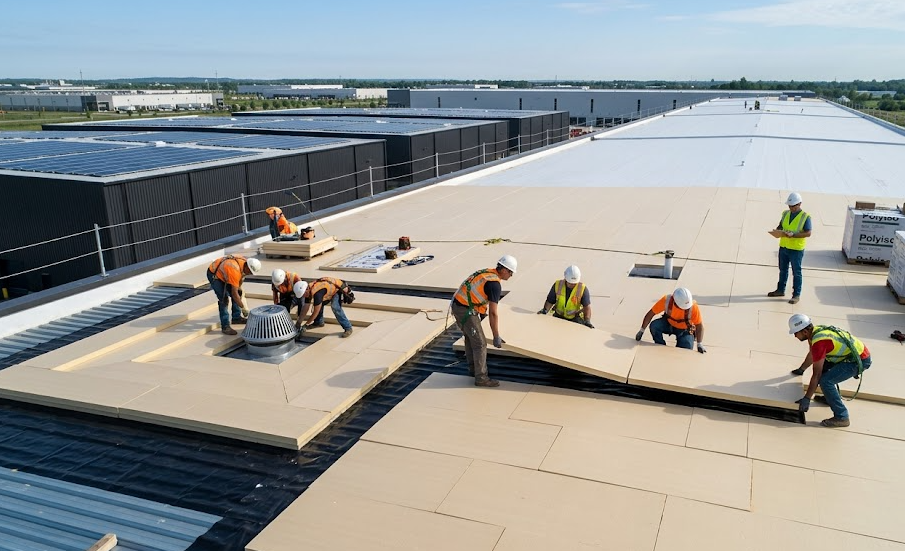
Unlike traditional single-layer insulation layouts that leave open paths for heat to escape through continuous panel joints, advanced thermal optimization programs mandate the use of at least two separate layers of Polyiso insulation installed with staggered, offset joints. By offsetting the panel seams between the top and bottom layers, you completely seal off the continuous pathways that allow air to leak out, creating an unbroken thermal shield across your entire roof deck.
Additionally, to eliminate the heavy weight of standing water pools without overloading your building’s structural columns, engineers utilize custom-designed tapered insulation systems. These specialized boards are factory-cut with a precise, built-in slope—typically 1/4-inch per foot—that channels rainwater directly toward your roof drains and scuppers.
By replacing heavy, poured concrete slopes with lightweight, high-performance tapered Polyiso, you protect your building’s structural frame from stress while gaining clean, dry roof surfaces that extend the lifespan of your outer waterproof membrane.
The Strategic Advantage: Data-Driven Portfolios and Asset Longevity
While premium staggered Polyiso systems isolate a building’s interior from extreme external weather, maintaining absolute efficiency across large commercial portfolios requires an organized, data-driven management strategy. This is where modern thermal envelope optimization programs transform facility operations, combining high-resolution thermal tracking with centralized cloud dashboards to manage building performance with extreme precision.
Instead of guessing which properties are losing energy, asset managers can leverage real-time utility data and structural thermal maps to identify insulation weak spots across their entire portfolio instantly.
   [Automated Code Generation & Validation Flow]

   Step 1: Structural Thermal Scan ----> [ Scanners map out hidden heat leaks across the roof ]
   Step 2: Offset Insulation Layout ---> [ Software designs staggered panel configurations ]
   Step 3: Centralized Energy Update --> [ Managers track facility utility drops on a single hub ]
By gathering accurate building energy data, monitoring HVAC load changes, and analyzing sub-surface insulation health, thermal envelope optimization programs. an experienced commercial roofing team can target thermal weak spots long before they trigger a mechanical equipment failure.
For example, because compressed or wet insulation boards lose their thermal resistance rapidly, high-resolution thermal scans can easily spot energy leaks as glowing hot spots during winter heating cycles. This allows your team to patch minor membrane tears early, preventing localized moisture from spreading across the entire insulation layer.
When you stream these real-time field insights straight into a centralized asset management dashboard, tracking property upgrades becomes completely seamless. Instead of letting critical utility data or warranty certificates get lost in scattered spreadsheets, facility directors can easily monitor energy efficiency benchmarks, manage contractor validation documents, and track project success across your entire property portfolio using one single hub Commercial Roof Inspections Guide: Surviving Annual Audits.
Moving away from old-school paperwork and embracing modern asset tracking permanently eliminates unexpected utility thermal envelope optimization programs. spikes while drastically extending your property’s operational life.
The Five-Stage Thermal Optimization Framework
Successfully transforming raw insulation materials and vapor barriers into a high-performance, energy-saving roof shield requires an thermal envelope optimization programs. organized, step-by-step construction protocol. You cannot rely on unverified field methods or casual scheduling.
To ensure your facility gains absolute protection against heat loss and structural moisture, your installation team must follow a strict five-stage engineering framework built around thermal envelope optimization programs.
  [Integrated Cloud Telemetry Pipeline]
  +-------------------------------------------------+
  | Comprehensive Structural Thermal Evaluation     |
  |                                                 |
  |      +-----------------------------------+      |
  |      | Multi-Layer Staggered Insulation  |      |
  |      +-----------------------------------+      |
  |                                                 |
  |            +------------------------------------+
  |            | Cloud-Synced Asset Energy Logging  |
  +-------------------------------------------------+
1. Complete Structural Thermal Evaluation
The framework begins by performing a comprehensive thermal audit of the thermal envelope optimization programs. existing roof assembly using infrared scanners and core moisture tests. This initial evaluation provides an accurate baseline map of your building’s energy performance, identifying exactly which insulation zones are wet or failing and giving your design team a thermal envelope optimization programs. clear guide for the optimization plan.
2. Install the Continuous Air and Vapor Barrier
Once the old, failing insulation is removed down to the bare structural deck, technicians install a heavy-duty, self-adhering air and vapor barrier across the surface. Every seam is rolled tightly to form a continuous seal that prevents humid interior air from thermal envelope optimization programs. creeping up into the new insulation boards.
3. Lay the Multi-Layer Staggered Polyiso System
Install the premium polyisocyanurate insulation boards in multiple layers, ensuring that every panel joint in the top layer is offset by at least 6 inches from the joints below it. This staggered layout completely seals off air paths thermal envelope optimization programs. and minimizes linear thermal bridging across the roof field.
4. Configure the Tapered Drainage Drainage System
Position custom-cut tapered Polyiso boards around all roof drains, scuppers, and valleys, establishing a continuous, code-approved slope. This precision configuration ensures all rainwater drains off the roof thermal envelope optimization programs. surface quickly, preventing heavy puddles from forming over low thermal envelope optimization programs. spots.
5. Final Post-Installation Validation and Asset Logging
After the outer waterproof thermal envelope optimization programs. membrane is sealed in place, engineers perform a final thermal verification scan to ensure absolute system integrity. All product R-value certifications, installation photos, and updated building energy profiles are then logged directly into your centralized asset dashboard for permanent record-keeping.
Analyzing Lifetime Operating Costs: Standard Code Roofing vs. Optimized Thermal Programs
Let’s look at real-world facility operating numbers to understand why continuing to install basic, code-minimum roof insulation can quietly drain your company’s annual building budget. Many organizations try to save money upfront by choosing single-ply insulation layouts that just barely meet basic local building codes.
However, when you calculate the real costs of continuous thermal envelope optimization programs. HVAC strain, premature cooling equipment replacements, and the steady rise of commercial electricity demand charges, reactive maintenance quickly becomes an incredibly expensive choice.
Consider a major commercial distribution center featuring 100,000 square feet of low-slope roof thermal envelope optimization programs. space.
An uncertified contractor quotes a standard re-roof job, using a single layer of insulation held down by mechanical screws to minimize upfront installation costs.
A professional local building science team quotes a comprehensive energy efficiency package, implementing an advanced thermal envelope optimization programs layout that combines multi-layered staggered Polyiso, a continuous vapor barrier, and a custom-sloped tapered drainage plan.
If the facility director chooses the basic, single-layer option to save on upfront costs, the building will remain vulnerable to heavy thermal bridging and air leaks year after year. The HVAC systems will Roof Albedo Optimization: How Cool Roof Polymers Fight Urban Heat Island Effect be forced to run continuously to counter the heat transfer, leading to frequent mechanical failures and high utility bills.
Let’s look at how the real operating and energy costs add up over a 25-year facility thermal envelope optimization programs. lifecycle:
  [25-Year Commercial Facility Energy & Maintenance Expenses]

  Code-Minimum Roof:         [$$$$$$$$$$$$$$$$$$$$] $542,000 (Includes Excessive HVAC Energy Overhead)

  Optimized Thermal System:  [$$$$$$$$$$$$] $326,000 (Permanent Utility Drops & Smooth HVAC Operation)
                             ===========================================================
                             True Long-Term Corporate Savings: $216,000 saved via advanced thermal engineering
| Facility Operational and Energy Expenditures (25 Years) | Code-Minimum Single-Layer Roof | Optimized Thermal Envelope Program | Net Corporate Savings |
| Initial System Installation Cost | $115,000 | $165,000 | -$50,000 |
| Premature HVAC Compressor Overhauls | $64,000 | $12,000 | +$52,000 |
| Sub-Surface Condensation Repairs | $48,000 | $0 | +$48,000 |
| Standing Water Structure Adjustments | $35,000 | $0 | +$35,000 |
| Cumulative Extra HVAC Energy Bills | $280,000 | $149,000 | +$131,000 |
| Total 25-Year Lifecycle Expenses | $542,000 | $326,000 | +$216,000 Saved |
Look at that significant bottom-line difference over a long timeline. Choosing the basic, code-minimum option actually cost the organization an extra $216,000 in entirely avoidable energy overhead and premature equipment replacement costs, proving that low-grade insulation layouts generate massive financial liabilities for your company over time. Running a large commercial property without using precise thermal planning is an incredibly expensive gamble.
The only reliable way to protect your physical real estate assets and slash your operating bills is to thermal envelope optimization programs. design real structural energy efficiency straight into your ongoing facility planning.
Technical Performance Matrix: Systems Under Intense Thermal Loading
The structural gap between basic roofing practices and high-performance thermal thermal envelope optimization programs. optimization programs becomes completely clear when you look at how different thermal envelope optimization programs. approach levels handle intense daily temperature swings, air leaks, and sub-surface moisture.
   [Commercial Energy Efficiency Spectrum]

   CODE-MINIMUM SINGLE LAYER: [*] High Energy Leakage / Vulnerable to Linear Thermal Bridges
   BASIC TWO-LAYER ASSEMBLY:  [***] Moderate Insulation / Lacks Continuous Vapor Seals
   OPTIMIZED THERMAL SHIELD:  [*****] Absolute Energy Control / Full Staggered Joins with Air Barriers
| Roof Component Isolation Property | Code-Minimum Single-Layer Roof | Standard Two-Layer Assembly | Advanced Optimized Thermal Shield |
| Linear Thermal Bridge Block | Poor (Metal screws create open leaks) | Moderate (Standard panel coverage) | Absolute (Staggered boards completely block heat paths) |
| Continuous Vapor Drive Seal | None (Humid air seeps through joints) | Low (Relies entirely on tape lines) | Perfect (High-bond self-adhering barrier stops all vapor) |
| Tapered Rainwater Drainage | None (Relies entirely on structural deck sloped lines) | Moderate (Basic crickets around drains) | Exceptional (Full field tapered system drains all puddles) |
| Long-Term R-Value Retention | Low (Air leaks cause early drop) | Moderate (Standard long-term performance) | Maximum (High-density cores preserve rated thermal values) |
| HVAC Operational Load Relief | Poor (Cooling towers redline constantly) | Moderate (Standard energy reduction) | Flawless (Cuts total peak demand energy needs by up to 35%) |
Connecting Telemetry Data to Predictive Financial Planning
Integrating high-resolution field analysis directly into your enterprise asset management workflow does more than thermal envelope optimization programs. optimize immediate maintenance tasks; it completely transforms your long-term capital allocation strategy. Instead of projecting future facility overhead costs using basic historical averages or arbitrary lifespans, executive teams can leverage thermal envelope optimization programs. precise degradation maps to predict exact structural replacement Thermal Envelope Optimization Programs cycles with unmatched accuracy.
This continuous flow of real-time field information allows financial directors to transform unpredictable emergency capital expenditures into smooth, highly scheduled structural upgrades. By eliminating the massive financial variance associated with catastrophic roof failures, your organization can keep liquid capital working across high-yielding investments rather than leaving it trapped in an emergency building reserve fund.
FAQ Section
What is a thermal bridge in commercial roofing insulation?
A thermal bridge is a localized area where a highly conductive material—such as a metal fastener or steel screw Thermal Envelope Optimization Programs penetrates through your roofing insulation. This creates an open structural pathway that allows heat to transfer rapidly out of or into your building envelope, thermal envelope optimization programs. bypassing your insulation entirely.
Why does polyisocyanurate require staggered joints during installation?
Installing Polyiso panels with staggered, offset joints ensures that no panel seams align between the top and bottom layers. This offset layout completely blocks the linear pathways that allow climate-controlled air to leak Thermal Envelope Optimization Programs out of your facility, maximizing your roof’s real thermal resistance.
How does an air and vapor barrier prevent roof deck rust?
A continuous air and vapor barrier is glued directly to the structural deck, blocking warm, humid interior air from rising up through your insulation joints. This barrier prevents that moisture from hitting the cold underside of your outer roofing membrane, stopping rust-causing condensation from forming.
Can tapered insulation boards be installed over a completely flat roof deck?
Yes, absolutely. Tapered insulation boards are factory-cut with a built-in, sloped profile specifically designed to introduce a consistent slope to completely flat structural roof decks. This system channels rainwater directly toward your drains without adding heavy dead-weight to your building framework.
How does thermal envelope optimization lower peak utility charges?
Commercial electricity providers often charge higher rates during peak-demand afternoon hours when cooling systems are running at maximum capacity. By minimizing daily heat transfer through your roof, an optimized thermal envelope reduces your facility’s peak cooling load, significantly cutting your demand charges.
What is the difference between R-value and continuous insulation?
R-value measures a material’s internal resistance to heat flow—the higher the number, the better its insulating power. thermal envelope optimization programs. Continuous insulation refers to an uninterrupted layer of insulation installed across the structural deck without any thermal bridges, ensuring your roof achieves its full rated thermal performance.
Securing the Foundation of Your Enterprise Portfolio
Protecting your enterprise facilities isn’t about waiting for an obvious structural leak or an expensive mechanical HVAC breakdown to disrupt your Thermal Envelope Optimization Programs daily business operations—it’s about respecting the true value of your real estate investments and actively using modern, energy-efficient systems to solve infrastructure issues long before they hit your balance sheet. Every unoptimized insulation panel you accept, Thermal Envelope Optimization Programs every installation step you rush through, and every dollar you spend on temporary surface repairs drains your corporate capital. By investing in an engineered, multi-layered thermal maintenance program, you ensure your properties stay completely efficient, safe, and profitable through every season.
Take a highly analytical look at your organization’s current property energy bills and roofing maintenance records. Replace basic, code-minimum insulation layouts with advanced, multi-layered thermal systems, and run your energy efficiency workflows Thermal Envelope Optimization Programs through a highly experienced, specialized team. Your facility’s net operating income will show the transformation.When chief financial officers, commercial facility directors, and asset managers review their annual property operational expenditures, they naturally scrutinize the most visible line items: mechanical HVAC service contracts, interior LED retrofits, smart automated lighting arrays, and real-time utility tracking software. Yet, the single largest driver of thermal envelope optimization programs. unnecessary corporate energy waste silently occurs directly above their boardrooms, offices, and assembly lines.
Traditional commercial roofing asset management has historically viewed the roof assembly as a simple, passive umbrella Thermal Envelope Optimization Programs a basic single-ply skin designed solely to block vertical rainfall. However, from a thermodynamic perspective, an unoptimized commercial roof acts as a massive energy sieve, continuously leaking conditioned air and radiating expensive climate-controlled energy straight into the atmosphere.
During extreme summer peaks and severe winter drops,Thermal Envelope Optimization Programs commercial structures without comprehensive thermal envelope optimization programs experience massive, uncontrolled heat transfer. In the summer heat, uninsulated roof decks absorb solar energy and radiate it downward, forcing massive chillers to work overtime. In the winter, valuable heat rises rapidly, escaping right through Thermal Envelope Optimization Programs sub-standard roofing insulation cores.
                         [ Relentless External Thermal Loading ]
                                       \     \     \
                                        v     v     v
   UNMITIGATED HEAT TRANSFER ===>     +-----------------+
  (Forces HVAC systems to redline) -> | Thin Insulation |
                                      | Thermal Bridges |
                                      | Utility Spikes  |
                                      +-----------------+
Waiting for a complete mechanical HVAC breakdown before upgrading your facility’s underlying thermal barrier is an incredibly expensive administrative oversight. The moment your building’s roof insulation loses its rated thermal resistance, your climate control systems are forced into a state of continuous over-activation. This relentless operational strain accelerates mechanical component wear, drives up monthly peak-demand utility charges, and shortens the lifespan of multi-million-dollar cooling towers.
To permanently insulate high-value corporate investments from these hidden operational losses, modern building engineering has shifted away from old-school, single-layer roofing installations toward a highly technical, multi-layered solution: thermal envelope optimization programs.
                        extreme environmental weather --->
            ____________________________________________________
           /                                                    \
          /        UNCONTROLLED INFRARED HEAT TRANSFERS         \
         /                                                      \
        v                                                        v
  +----------------------------------------------------------------+
  | [Engineered Thermal Envelope Optimization Shield]              |
  |   \__ Staggered Polyiso Joins, Air Barriers & Tapered Drainage |
  |                                                                |
  |          Flawless Protection & Drastic Utility Overhead Cuts   |
  +----------------------------------------------------------------+
Modern commercial property development requires looking far beyond basic waterproof membranes. Real, long-term asset protection demands a complete structural upgrade of the building envelope’s thermal layers. By pairing the exceptional thermal resistance of multi-layered polyisocyanurate (Polyiso) insulation boards with high-bond continuous air and vapor barriers, industrial commercial properties can completely isolate their internal environments from external weather extremes.
When you link precise building science calculations with high-density insulation materials, managing large commercial properties becomes completely systematic and predictable. Instead of fighting sudden utility spikes, uneven interior zone temperatures, and frequent tenant comfort complaints, facility directors can track their insulation thermal performance data, organize structural building energy records, and evaluate long-term energy savings on a single digital timeline.
Shifting from standard, code-minimum roofing retrofits to a comprehensive, engineered thermal program is the single most effective way to eliminate unexpected infrastructure decay, lower annual carbon footprints, and maximize net operating income for decades to come.
QUICK TAKE / SNAPSHOT BOX
- Eliminates Linear Thermal Bridges: Installing insulation boards in a multi-layered, staggered-joint configuration stops conditioned air from escaping through open panel seams.
- Blocks Sub-Surface Vapor Drive: Deploying a high-bond continuous air-vapor barrier prevents humid interior air from condensing and rotting internal roof assemblies.
- Provides Automatic Puddle Drainage: Custom-engineering sloped, tapered insulation configurations channels standing water off low-slope roofs without adding structural dead-weight.
- Maximizes Long-Term R-Value Retention: Utilizing high-density polyisocyanurate cores delivers the highest thermal resistance per inch of thickness compared to standard insulation materials.
- Drastically Lowers Peak Energy Demands: Minimizing daily thermal transfers reduces total commercial air conditioning and heating electricity consumption by up to 35%.
- Accelerates Net Corporate ROI: Investing in high-performance thermal barriers often pays for itself within a few operating seasons through permanent utility bill reductions.
The Thermodynamic Mechanics of Commercial Heat Loss
An early loss of thermal efficiency across a commercial low-slope roof deck is rarely caused by mechanical wear alone. Instead, it is driven by two continuous, invisible structural forces working against each other: unmitigated thermal bridging and sub-membrane vapor condensation.
When a commercial roof installation relies on a single, thick layer of insulation panels held down by standard metal fasteners, it creates thousands of tiny structural pathways for heat to escape, a process known as linear thermal bridging.
                         [ Unmitigated Linear Thermal Bridging ]
                               |     |     |     |
                               v     v     v     v
   FASTENER HEAT TRANSFERS ===>  +-----------------+
  --------------------------->| Single Panel    |
                              |                 |
                              | Open Seam Gap   |
                              | Vapor Trapping  |
                              +-----------------+
Because metal conducts heat hundreds of times faster than insulation material, every single steel screw driven through the roof deck acts as a mini thermal radiator. During cold winters, these metal fasteners pull heat directly out of your interior spaces and dump it into the cold sky; in hot summers, they pump searing exterior heat straight down into your air-conditioned rooms.
When a commercial building lacks specialized thermal envelope optimization programs, three distinct physical failure vectors can quietly compromise the entire facility:
1. Conactive Air Leakage and Joint Separation
As a large commercial building settles and shifts throughout the seasons, single-layer insulation boards experience minor physical movement. Without a multi-layered barrier to cover these shifting lines, panel joints slowly separate, opening wide internal pathways that let expensive, air-conditioned air leak continuously out of the building envelope.
2. Sub-Surface Dew Point Convective Condensation
During cold winter periods, warm, humid air inside a commercial facility naturally rises toward the ceiling. If the roof lacks a continuous air and vapor barrier, this humid air seeps upward through the insulation joints until it hits the cold underside of the outer waterproof membrane, instantly condensing into liquid water that rusts structural steel decks and rots internal drywall.
3. Progressive Structural Dead-Weight Ponding
When a flat roof lacks proper slope, rainwater pools into large standing puddles across low spots. Over time, the heavy weight of this standing water deflects the underlying steel structure, creating permanent sags that trap even more water. This standing pool puts intense structural stress on the roof frames and leads to rapid membrane wear.
  [Cross-Section of a Thermal Insulation Assembly Failure]

  Layer 1: Open Panel Seam Gaps ------> [ Let conditioned interior air escape unchecked ]
  Layer 2: Fastener Thermal Bridges --> [ Metal screws act as active channels for heat transfer ]
  Layer 3: Condensed Sub-Surface Water -> [ Wet insulation boards completely lose thermal resistance ]
Relying on basic visual roof checks to manage these complex thermodynamic issues is a major mistake. By the time a facility team notices a water spot on an interior ceiling panel, wet insulation boards have often been losing thermal resistance for years behind the scenes.
True structural efficiency requires moving past simple superficial fixes and building an advanced defense line that treats the entire roof system as a highly efficient energy barrier.
The Engineering Strategy: Staggered Polyiso and Tapered Slope
To defeat continuous thermal bridging and stop internal moisture damage before it starts, modern commercial building science relies on a brilliant layout: multi-layered polyisocyanurate insulation boards combined with precision-sloped tapered systems. This is not a basic arrangement of standard foam boards; it is an engineered structural system designed to provide maximum thermal resistance while ensuring flawless water drainage across low-slope roof assemblies.
  [Optimized Commercial Multi-Layer Thermal Design]
  +-------------------------------------------------+
  | Premium High-Density Polyiso Cover Board        |
  |                                                 |
  |      +-----------------------------------+      |
  |      | Staggered-Joint Polyiso Core (Layer 2) |    |
  |      +-----------------------------------+      |
  |                                                 |
  |            +------------------------------------+
  |            | Offset Base Polyiso Layer (Layer 1)|
  |            +------------------------------------+
  +-------------------------------------------------+
Unlike traditional single-layer insulation layouts that leave open paths for heat to escape through continuous panel joints, advanced thermal optimization programs mandate the use of at least two separate layers of Polyiso insulation installed with staggered, offset joints. By offsetting the panel seams between the top and bottom layers, you completely seal off the continuous pathways that allow air to leak out, creating an unbroken thermal shield across your entire roof deck.
Additionally, to eliminate the heavy weight of standing water pools without overloading your building’s structural columns, engineers utilize custom-designed tapered insulation systems. These specialized boards are factory-cut with a precise, built-in slope—typically 1/4-inch per foot—that channels rainwater directly toward your roof drains and scuppers.
By replacing heavy, poured concrete slopes with lightweight, high-performance tapered Polyiso, you protect your building’s structural frame from stress while gaining clean, dry roof surfaces that extend the lifespan of your outer waterproof membrane.